
































Animal Products
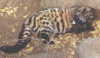
From the "Civet Cat", Viverra Civetta
The original source for quality Civet was Ethiopia where the paste like substance was packed and shipped in Zebu Horns. India and China also produce significant amounts but many countries in the Asian continent have small cottage industries where families keep a single "cat" or two. The cats produce a sticky substance from a gland near their bottoms and wipe them on trees to mark their territories and attract mates. It is quite possible then to follow the cats around and scrape the Civet off of the tree. Sadly however, the cats are kept in small cages and teased on a regular basis to promote the production of Civet. The less cruel owners will have a larger cage with a vertical pole that the cat can wipe itself on but others will keep them in cages only a little bigger than the cat itself and scrape the behind of the cat to recover the paste.
Civet is a dark brown paste and has a pungent almost fecal smell. However on familiarity with the material most will start to see an almost "fragrant" quality which becomes even more apparent on high dilution. At around 0.1% it is quite Muguet (Lily of the Valley) like. This combination of notes therefore makes Civet a useful contribution to add depth and naturalness to many floral type perfumes. The animal character fits nicely into a Chypre style perfume (Miss Dior, Aramis, Paloma Picasso etc.)
Civet is usually used as a tincture in alcohol (around 3% in absolute alcohol) and as with all animal product tinctures should be matured at room temperature (c. 20 C) for at least 3 months before use. An absolute can be produced by evaporating off the alcohol.
Alternatives to Civet with some of the characteristics are Civet
Fleuressence
ä
, Skatole (Methyl Indol), Civettone, Costus Oil
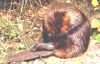
From the Castoreum Beaver, Castor Fiber
The Castoreum Beaver has at its rear end a pair of oil glands used for oiling and waterproofing its fur. Beavers love to live among trees and cut them down to make small dams to produce their private fishing lakes. Unfortunately they choose do this conspicuously in areas where foresters are trying to grow trees for commerce. The beaver is regarded as a pest in Canada and some of the former Russian States and Eastern Europe. So it is regularly culled to limited numbers and damage to the timber forests. The culled Beavers are skinned for their fur and the oil glands collected. The oily secretion is highly fragrant and probably has a role in marking territory. The glands are sun-dried and look something like a pair of pitted prunes joined together. The glands can be used as a tincture (up to 20%) after maturation or an absolute is produced.
Natural Castoreum has a strong and very rich leather like note, not really fecal although those unfamiliar with it might find it highly unpleasant. A must in Leather, Chypre and most Men's types. Can be used with Oriental and Fougere types but does not generally fit easily into natural flowery perfumes.
Alternatives with some of the characteristics of Castoreum are Castoreum Fleuressence ä , Labdanum Absolute, Cistus Oil, iso-Butyl Quinolene.
Ambergris
From the Sperm Whale, Physeter Catodon
The Sperm Whale loves to eat cuttle fish, unfortunately these tasty morsels for the whale have their revenge. Their sharp triangular bones scratch and tear at the intestines of the whale causing them to bleed. In defense the Whale is believed to produce the pussy pathological substance that we know and love as Ambergris. You can imagine that the freshly produced Ambergris is quite an unpleasant matter, mixed with feces, blood and bones as it is ejected from the Whale (the discussion continues which end?). The brown to black "squiggy' mass floats on the sea and slowly the unpleasant fecal smell and dark color fades as it bathes in the sunshine and salty water. After a few months to a couple of years the mass, now waxy and gray to amber colored, may find itself washed ashore, a treasure for a beachcomber more than likely in New Zealand or Australia, .
Ambergris is collected from whales harvested for their meat and blubber but you will realize from reading above that it is not a very pleasant material at this stage and of comparatively low value.
Quality Ambergris is a gray to amber smooth waxy mass with an gritty almost sandstone appearance. Its odor is dry, soft and animalic. (I find it reminds me of elephant dung). Used as a matured tincture in absolute alcohol it ca be use in just about every fragrance imaginable including even light florals and citrus colognes. It adds a soft radiant effect at correct dosing but may become powdery in excess which is useful for Chypre and Leather notes.
Alternatives with some of the characteristics of Ambergris are Ambergris
Fleuressence
ä
, Ambroxan, Costus Oil
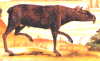
From the Musk Deer
The small and shy Musk Deer is a rare sight even in its natural habitat of the Tibetan mountains. Unfortunately it has a treasure that is perhaps worth many years salary to a poor farmer or shepherd who will kill it on sight to reap the abdominal gland for which it is so highly prized. The leathery gland or "pod" around 4-5 cms diameter, covered on its upper side with hair and filled with waxy grains of musk weighs in at only 30 grams or so. A single pod can fetch on the now, illegal market, around US$4,000 to 5,000 (or US$150,000 per Kilogram).
In India and Russia there are programs to farm the deer but reports vary as to the success. I suspect even if these programs are successful the fact will remain a closely regarded secret as the Pods can maintain an over inflated price as black market commodities.
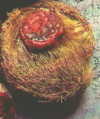
The grains from the pods (about 3%) are steeped in alcohol to produce a tincture which must be matured for at least 3 months.
Alternatives to Musk are Musk Fleuressence ä , Musk ketone is the single material that most resembles natural Musk in odour profile but has none of the lift and radiance that natural Musk imparts to fragrances. Some of this smoothness and radiance is captured by the synthetic musks Ambrettolide, Exaltolide and Ethylene Brassylate but the poor relations Galaxolide, Tonalid don't come up to spec.
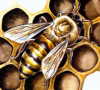
From Beeswax recovered from hives
Included more for completeness, I would normally keep this with floral absolutes. An absolute can be produced from beeswax by simple maceraction /extraction with alcohol. The quality is dependant on the bees food scource but can be a quite interesting product to add naturalness to florals and a honey note where required.
Alternatives are Beeswax Fleuressence ä , Phenyl Ethyl Phenyl Acetate, Honey Fleuressence ä , Ethyl Phenyl Acetate