Isolates
Isolates may have names like Eugenol, Cinnamic Aldehyde, Citral, d'limonene, l-carvone, alpha-pinene, geraniol, citronellol.
Now these are chemical names, so how can we put them in an artical on Essential Oils?
This is because natural plants like factory plants are little chemical powerhouses. The essential oils that they produce are just mixtures, albeit very complex mixtures, of chemicals.
Now, with what you know so far, you will realise that chemical molecules come in all shapes and sizes, some dissolve in water and others in oils some evaporate quickly and others very slowly. And it is essentially (excuse the pun) these factors that lead us to isolates.
When we heat an essential oil the more volatile chemical components will tend to evaporate first. If we could control the temperature (and pressure) very-very accurately we could almost control it so that each one present in an essential oil would evaporate one by one and completely separately from the others. In practice for all sorts of complex reasons this is almost impossible on a commercial scale but I think you get the idea.
Because we are using a physical means (viz. heat) and we are not chemically modifying them in any way, as they merely evaporate and recondense - we say that these materials are natural isolates.
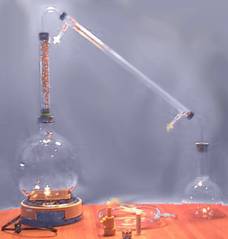
Apparatus from www.florachem.com
|
Fractional Distillation
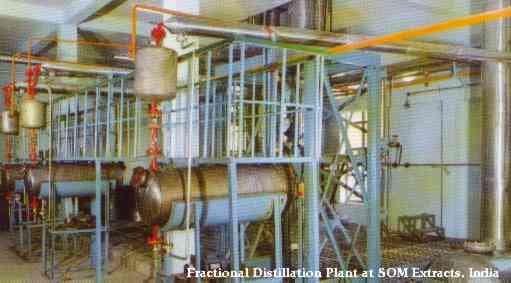
Commercially the process most commonly used to isolate chemicals from essential oils is called "fractional distillation" The material is heated (maybe under vacuum) and the vapor rises into a long column above the still. The column is filled with many objects on which the vapor can repeatedly condense and reevaporate as it moves toward the top, effectively distilling the vapor many times. The less volatile substances in the vapor tend to run back down the column after they condense, concentrating themselves near the bottom. The more volatile ones tend to re-evaporate and keep moving upward, concentrating themselves near the top. Because of this the column can be tapped at various levels to draw off different fractions. |
|
| ||
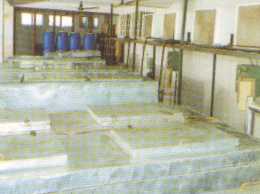 | Another method of producing isolates from essential oils is by cooling. An example is the production of Menthol which is is isolated from Peppermint Oil by freezing.
The Menthol Crystals fall out of solution and precipitate, they are then filtered out, as at this plant at Som Extracts in India |
 |
There are other methods for separation that use solubility but Fractional Distillation is the most common.
Some oils and their isolates that you are likely to come across.
|
|
|
| Lemongrass Oil
Citronella Oil Clove Oil Geranium Oil Orange Oil Ho Oil Pine Oil Sandalwood Oil Vetiver Oil | Citral
Citronellol, Geraniol and Citronellal Eugenol Rhodinol (Mixture of Citronellol and Geraniol) d'limonene Linalool Pinene Santalol Vetiverol |
| Peppermint Oil
Cedarwood Oil | Menthol
Cedrol |
|
|