




























How much Top, Middle and Bottom note should I use?
Unfortunately the question is too simple. This is a typical example of an answer that I read in an aromatherapy newsletter.|
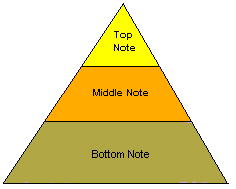
"Once you have determined the kind of scent you want, the next step in the process of creating a perfume is to recognize the top,middle and base notes. The top notes (lavender, lemon, geranium, etc.) are the initial scent you smell when first applying the perfume. These are volatile scents that evaporate quickly, fading to reveal the middle notes (geranium, jasmine, rose, ylang, etc.) which are the heart of the scent, giving it complexity and character. The base notes(sandalwood, ambergris, musk, myrrh, oakmoss, labdanum, vanilla, etc.) are the fixatives of the scent, adding depth and richness to the blend."
"For example: "Generally, a perfume consists of 3 parts (50%) top note, 2 parts (33%) middle note and 1 part (17%) base note. The reason the base note is proportionately lower is it's tendency to "take over" a scent blend, especially if the top and middle notes are delicate. I usually stick with the 3-2-1 combination, even when making richer, "exotic" scents." |
This is fine as it goes but on further examination of the question it becomes apparent that the question is the same as "How long should a piece of string be?" or when painting "How much Sky and Foreground should I use?". The answer of course depends on what you are trying to do or say with your perfume.
So try not to fall into the trap. The first step is to determine your objective for the perfume type, the odour required at different stages in its life and the function of the product. By all means start with 1 part of each (33.3% of each) and then develop it from there.