Distillation
| Most Essential Oils are produced by distillation. Essentially,
plant material such as leaves, flowers, wood etc. is arranged on plates in a receptacle, a 'Still'. The still in a laboratory is usually made of glass but for large scale production stainless steel is the preferred material. You will however see in old pictures that copper used to be used, but it is now regarded as too expensive and rarely seen except for public viewing set-ups. In primitive set-ups a second hand 45 gallon (200 litre) oil drum may suffice as the still with a an open fire or gas burner underneath.
Water is filled in the bottom of the still and heated or alternatively steam is injected into the still from an outside boiler. A third method is a combination of water and steam. Pure steam is generally more efficient but some materials with a waxy nature such as flower petals may tend to stick together, in this case the water method is the preferred choice. The distillation of Rose Oil ('Otto') is such an example of where water distillation is successfully used. 
A condenser in its simplest form is just a long pipe that allows the oil and steam mixture to cool down. This can be best seen on some farms in Indonesia where a drain pipe is used. In a modern still the condenser will have cold water flowing over the outside to make the cooling as efficient as possible and prevent losing oil into the atmosphere. The cooling water may be a coil that runs around the condenser or a water jacket (a bigger pipe closed over the condenser with an inlet and outlet for the cooling water). . 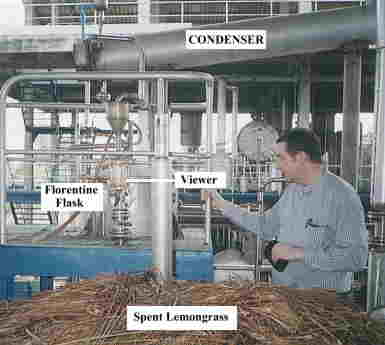
The oil gathered, the 'Essential Oil', is usually a light color, as the color molecules in the plant material, such as chlorophyll are large and non-volatile and cannot be vaporized and carried over with the steam. Some dark colored oils such as Vetiver and Patchouli are dark because of an interaction between the iron material in the still and condenser (e.g. with simple steel drums or poorer grades of Stainless steel) rather than any color from the natural plant material. An Essential Oil that is freshly distilled will have a gassy green note that on proper airing will fade after the first few weeks. This "still note" is from sulfuraceous products formed from reactions of the plant material and the hot steam in the still. |